


AI Music Search vs Traditional Music Libraries: Which Is Better?A Complete Comparison for Content Creators and Marketers
- 熙 杨
- Apr 24
- 3 min read

🎯 Quick Answer
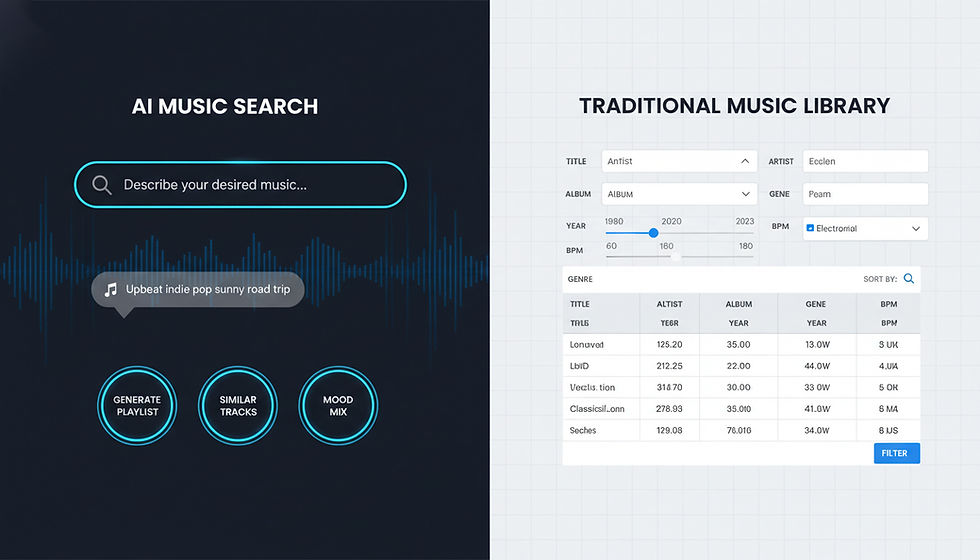
For most content creators today, AI music search is the more efficient, faster, and scalable solution compared to traditional music libraries.
AI music search → fast, mood-based, beginner-friendly, high scalability
Traditional music libraries → manual filtering, slower, requires experience
👉 AI music search allows for faster, more intuitive music discovery, making it an ideal solution for modern video creators and marketers.
🧠 What Is the Difference?
AI Music Search
AI tools allow you to find music by simply describing what you need in natural language, without needing any knowledge of music theory. For example:
“Emotional piano for storytelling”
“Upbeat fast music for ads”
👉 AI processes your intent and context to find the best matches almost instantly.
Traditional Music Libraries
Traditional music libraries rely on manual search methods using filters and tags such as:
Genre
BPM
Instrument
👉 This approach requires more time, effort, and a basic understanding of music terminology.
⚖️ AI Music Search vs Traditional Libraries
Feature | AI Music Search | Traditional Libraries |
Speed | Very fast | Slow |
Ease of Use | Beginner-friendly | Requires experience |
Search Method | Natural language input | Filters & tags |
Accuracy | High (context-based) | Medium (depends on user input) |
Scalability | High | Limited |
Learning Curve | Low | High |

🧠 When Should You Use Each?
Use AI Music Search When:
You want fast, accurate results
You don’t know music terminology
You need mood-based music matching
You create content frequently
👉 AI music search is ideal for creators looking for speed and convenience. If you’re short on time or unfamiliar with music theory, AI music search is the solution for you.
Use Traditional Libraries When:
You want manual control over every detail
You understand music theory and know how to filter by genre, BPM, etc.
You’re searching for specific, niche technical details
👉 Traditional libraries are more suited for those who have the experience and are working on highly specialized projects where manual control is important.
🚀 Why AI Music Search Is Becoming the Standard
1. Speed
AI music search allows creators to find tracks in seconds instead of hours, which is essential for today’s fast-paced content creation environment.
2. Emotion-Based Matching
AI understands feeling, not just tags. It can match music to the emotional tone of your content, making the music more impactful and emotionally aligned with your video.
3. Simplicity
You don’t need to know BPM, genre, or technical music terms. Simply describe the mood or emotion you want to convey, and the AI handles the rest.
4. Better for Modern Content
With the rise of short-form videos, ads, and quick production cycles, AI tools provide faster, more efficient music discovery, which is essential for creators working with tight deadlines.
⚠️ Limitations to Know
AI Music Search
Less manual precision in rare cases
May not work well for very niche music where you need to match specific instruments or extremely precise details
Traditional Libraries
Time-consuming
Can be overwhelming for beginners
Often requires extensive experience and knowledge of music theory
🎧 Real Use Cases
Creator (YouTube / Shorts)
Uses AI → Speeds up content production with quick music selection for daily uploads and short-form content.
Brand / Ads
Uses AI → Achieves better emotional matches with the brand's message and targets higher conversion rates.
👉 For commercial projects, ensure your music is properly licensed. You can explore our commercial music licensing options at VividSound Library.
Professional Editor
Uses both → AI for quick music selection and traditional libraries for fine-tuning specific track details.

🔗 Related Articles
❓ FAQ
Is AI music search better than traditional libraries?
For most creators, yes — AI music search is faster, easier, and more intuitive, making it a better option for most use cases.
Can AI really understand music emotion?
Yes, modern AI models can effectively analyze mood, pacing, and context, matching music to video content in ways that manual filtering can’t.
Are traditional music libraries outdated?
Not completely — traditional libraries still provide value for creators who need manual control and have specific requirements. However, they are becoming less efficient and harder to use for fast, frequent projects compared to AI tools.
Which is better for beginners?
AI music search is much easier for beginners since it does not require knowledge of technical terms like BPM, genre, or key.
🚀 Final Thoughts
AI music search is not just a new feature —👉 it’s a new way of finding music.
While traditional libraries still have their place, AI is faster, easier, and better suited to modern workflows and creative processes.
🎯 Ready to find music faster?


Comments